Will W. Williams

Musician + Writer + Poet

Category: Short Fiction

  • The Man Who Could Not Stop Sighing

    The Man Who Could Not Stop Sighing

    There lived a man in the small town of Southington who had a family, a wife, and children. He had a job and hobbies and went to church. He was well-liked by all in the small town, though not overly so, but was liked just the right amount as to still be considered respectable.

    One Sunday, after coming home from church with his family in their sedan, a homeless man ran out in front of their car. The man slammed on the brakes, causing the car to screech to a halt just inches in front of the man in the street.

    The homeless man, however, was not rattled by this near-death experience and instead seemed to barely notice the large metal object with wheels that moments ago was flying at him at around 40 miles per hour. Instead, he knelt down in the street to pick up a small gold coin, which the man in the car thought must have been a penny.

    The homeless man brushed himself off and, with a mix of satisfaction and disappointment at his unfortunately meager discovery, shuffled off into the bushes at the side of the road.

    The wife and children had let out a loud gasp at the incident, and the children were yelling in the back of the car, asking what was going on.

    The man simply let out a long sigh upon seeing the homeless man wandering away, ragged and unkempt, and told his family everything was fine.

    Later that day, after eating a late lunch, one of the children was flipping through videos on their TV—you see, they were only allowed to watch TV on the weekends, and so the choice was quite crucial.

    What the child accidentally clicked on was a video about the war in the East, and the news reporter was speaking loudly, with urgency, about a recent bombing that had taken place. The mother rushed to the child, telling them to “turn that off immediately.” However, the husband only sat at the table, looked down at his almost empty plate, and let out another enormous sigh.

    For the man was not uncaring and not unfeeling, so naturally, seeing the state of things got to him, though he wished not that they would, and so, in his seniority and wisdom, all he could do was let out this long, weary sigh.

    Later that evening, after the children had gone to bed, the wife and husband lay—sitting up—in bed, both with books, as they did every night, reading a few pages before turning off the lights.

    “Honey,” the wife said, addressing the man as she closed her copy of the novel her friend had lent her. “Do you think we should be donating more? To the church, I mean. After all, you did just get that blessed raise.”

    The man let out a long sigh before replying.

    “Dear,” he began gently. “We still owe money on the car. And I’ve started saving for the children.”

    “Of course, honey, I understand,” she said before giving him a little kiss and turning off the light.

    The next morning, the man woke to the sound of the alarm clock, an old radio that they had repurposed to wake them up. On the radio was a man speaking about gas prices:

    “We are almost out of oil!” the man was saying with overexaggerated charisma. “Prices will only go up, up, up!”

    The man sighed and turned off the old radio. His wife was already awake and must have been in the kitchen.

    He dressed quickly and joined her at the stove, where she was making eggs.

    “Good morning, my dear,” he said, giving her a gentle kiss on the neck.

    Just then, the doorbell rang. The man moved towards the door and opened it to find their neighbor, the elderly Mrs. Clarkson, standing there in her slippers and bathrobe.

    “Your dog is in my yard again!” she said angrily. “I do not want this to keep happening!”

    The man sighed.

    “I’m sorry, Mrs. Clarkson. I’ll come get him right away.”

    The man followed Mrs. Clarkson into her house and into her backyard, where the family dog was barking fiercely at the elderly woman’s cat, which was up in a tree and hissing fiercely.

    Just then, a loud noise erupted above both of their heads. The man clutched his hands over his ears as an enormous military jet roared over him, shaking the trees around them.

    The man sighed again.

  • The Accordionist On Rue De Bienveillant (short story) 

    The Accordionist On Rue De Bienveillant (short story) 

    Simone worked at a small tobacco shop on the corner of Rue de Bienveillant in the heart of Paris. Her days were long and the job did not pay her well. She had always wanted to travel and explore the world—perhaps visit Japan or America. However, between her day to day worries and the rhythm of life in the city, she had never made the time to really look into it seriously.

    She had begun working at the tobacco shop when she was in school, however, during that time she had become pregnant and had never finished. Since then, she had stayed at the shop, working long hours to support herself and her daughter. 

    The street of Rue de Bienveillant was not unlike many of the smaller streets in Paris. There were times when it was quite busy, with many people walking through to the larger streets on either side. There were also times when it was so quiet that she wondered whether or not she was still in one of the grandest cities in the world or a small town to the south.

    During these quiet times, every now and then, an old man would sometimes begin to play his accordion in the street, a few shops down from Simone’s tobacco shop. She remembered hearing him playing when her daughter was only a few years old, and she had been so busy that she had never thought to stay and listen to him. She simply walked by him and would toss a few coins in his basket. 

    But over the years as things slowed down and Simone began to settle into her life, she noticed the old man more and more. She often wondered as she would pass him after leaving work why the man did not play during the busiest hours, but instead seemed only to play during the quiet times, late at night. 

    She suspected that the man lived in one of the apartments above the street, and perhaps came down to simply enjoy the sound of his music out in the city. 

    One night, she had had a particularly stimulating day in the shop—as a group of raucous foreign businessmen had spent a few hours there, talking to her about their travels—and so, being in such good spirits, she decided to stop and speak with the old accordionist. 

    “Why don’t you play along the big street, on the corner?” She said quickly, as she tossed a large handful of coins into his basket. She noticed that it had been empty before she did this, as it always was. But the old man only shook his head dismissively, and continued to play. 

    “What is your name?” She asked, determined to learn something, anything, about this man. 

    He looked up at her, still playing, his face very old and his eyes full of sadness. He said nothing, only continued to play. 

    “Well,” Simone continued, startled by the man’s eyes. “I hope you have a splendid night, Monsieur. I very much enjoy your music.”

    She gave the man a nod of respect, understanding that he did not wish to converse with her, and then headed towards the metro and to her home. 

    She never spoke to the man after that, however, whenever she did pass him on the little cobblestone street, she still always threw a few coins into his basket. 

    ~ ~ ~

    Years later, her daughter had grown and was quite a fine young woman—quite beautiful and with strong academic promise. She had been accepted to a university in Tokyo with a full scholarship, and Simone had seen her off to Charles de Gaulle airport with more than a few tears in her eyes. 

    She did quite well, and though Simone kept in touch with her, the calls came more and more infrequently as her daughter became adjusted to her new life. 

    It was during these years that Simone began to become sick. Not severely so, but she began to feel bouts of tiredness and pain. 

    When she went to the doctor, they told her that she was unwell and would no longer be able to work at the tobacco shop. They said the smoke, from the years and years of it, had caused her to develop cancer. She could not afford the treatment, and so the doctor recommended rest. 

    Her daughter told her of a new treatment in Tokyo, but it was quite expensive. 

    “It looks very promising mother! You would just need enough for the visit and the treatment, I can help as much as I can, but you will still need to find the money.”

    Simone hung up the call, and let out a long sigh. She was so tired. She knew she would not be able to find the money, and so she lay down on her bed, listening to the city below her, and fell asleep. 

    She awoke several hours later to a knock at her apartment door. Standing up, slowly, she straightened her hair, wondering who it could be. She received very few visits these days. 

    She opened the door, expecting to see her friend Lea or possibly a neighbor in need of something, but there was no one there. 

    She glanced around, before noticing a small envelope on the floor in front of the door. She bent over, picked it up, and read the small, messily scrawled words on the unstamped envelope. 

    It read: 

    “From the accordionist on Rue de Bienveillant.”

  • String (short story)

    String (short story)

    Alfred was sitting on his bed, his neck half propped up against a quite unfortunately abused pillow, scrolling on his phone, when he felt a sudden itch in his nose.

    Reactively, he reached his left hand up to scratch it, thinking it may have been a speck of dust or a gnat or just a random itch, only half speculating. 

    With the itch resolved he lowered his hand. But then it came back, this time more immediate and much more irritating.

    Alfred stood up quickly and reached for the box of tissues by his bedside. He blew his nose firmly, thinking that this would be the end of it, balled up the tissue, and then tossed it in the small, plastic wastebasket in the corner of the room.

    As he turned to return to his bed, he looked down and noticed a piece of string—hanging right in front of him—hanging from none other than his left nostril. 

    His stomach lurched in disgust, and he stopped, reaching up carefully to remove it. But as he began to pull the string, it only kept unraveling and unraveling—longer and longer, coming from deep inside his nasal cavity. 

    Alfred was feeling a strange mix of terror and disgust as he kept pulling this mucus covered string from out of his nose, unsure if whether or not this would be his undoing. He pulled slowly on the string until some four feet’s worth of it hung in front of him with the end still not visible or noticeable in his nostril. 

    Finally, after about six feet of string slid irritatingly through his nasal canal, he felt a lurch and felt a clump inside his upper airway attached to the piece of string. 

    With disgust and panic he yanked the string hard with one pull and out of his nose came a little ball of paper, attached to the end of it. It landed in front of him on the floor. 

    Alfred looked at this strange thing, then glanced around wondering whether this was a dream of some sort. No, this was waking life, he was sure of it. But what on earth was this string doing inside his nose and how had he not felt it before? He knelt down beside the balled up piece of paper attached to the string and examined it. It seemed to be some kind of little crumpled up note.

    With disgust, he pried the mucus covered thing apart, a sense of dissociation coming over him at the strangeness of the situation, until it lay open in front of him.

    It simply read this: “smell yuh later.”

    Alfred sneezed, threw the note and string into the trash, and plopped back down on his bed to proceed to continue to scroll on his phone. 

  • Upside Down (Short Story)

    Upside Down (Short Story)

    It was a few minutes before six in the evening and I was waiting for the bus after leaving work to head home. It was an ordinary day and I had no reason to feel any differently than usual. I guess the only thing out of the ordinary that had happened was that I had seen something peculiar that morning. 

    When I had taken my first smoke break of the day, I had decided to take it on the roof of the office building where I worked. This was not unordinary, as I would either take my break there or outside the building in front of the entrance. 

    But as I had been smoking, I happened to glance up at the sky. I saw a white bird, of which kind I could not say, however, it was flying upside down. I squinted against the morning sun to be sure I was not confused, and sure enough, the bird circled the rooftop and then flew off to the east—the whole time flying upside down.

    Strange, I thought to myself, ashing my cigarette in the little ashtray the smokers of the office had placed there. I did not know that birds could fly upside down.

    I went back to work, thought nothing of it, and had finished the day as I normally would. I said a brief goodbye to Lindsay at reception and then took the short walk through the building and down the street to the bus stop. 

    But while I was waiting for the bus, the sun staring to set, the upside down bird came back to my mind. It had been beautiful in a strange way—graceful—and had I not looked closely I would have not noticed this strange behavior. 

    The bus pulled up and I climbed up the steps, giving a little nod to the driver, and then settled into a window seat in the back row. That was where I always sat. I always felt more comfortable being out of any stranger’s direct eye line. 

    After about twenty minutes, watching the city slide by with it’s grays and greens, we arrived at my stop—as any other day. But instead of standing up and shuffling off of the bus, I instead, stayed seated. 

    I am not sure why I did this—for it made no logical sense to stay on the bus. I knew the next few stops were mostly residential and I should go home and eat dinner—but my body simply seemed to decide that it was not going to move.

    Before I knew it, I guess I had fallen asleep, because I awoke to the bus driver tugging at my sleeve.

    “Last stop! You gotta move, sir.” 

    Confused and disoriented, I hazily stood up and exited the bus with the bus driver frustratedly shewing me towards the door. 

    The bus pulled away and I was left, standing there and rubbing the sleep from my eyes, under the flickering light of an unknown street lamp. 

    Where am I? I thought to myself. 

    I looked up at the street sign. Then I rubbed my eyes in confusion. I couldn’t understand it for the life of me. I walked towards it, feeling a strange sense of dread. 

    As I got closer, I realized that the letters were upside down, and—upon closer inspection and a twisting of my neck—I was able to read it. It said, Culvers Rd—the very same street that I lived on. 

    Ah, some kids must have vandalized it—switched the sign. I thought, relieved. Somehow I guess I had still ended up at my stop. 

    I began to walk down the street towards my house, approached the front door, fumbling loudly with my keys. 

    But before I could even put them in the lock, the door swung open. 

    “Mr. Johnston? Is everything alright?”

    I jumped in surprise and then looked up at—what I now realize—was the face of my neighbor. 

    “What are you doing in my house?” I said sharply, without thinking. 

    My neighbor—Mrs. Rhinestone—cocked her head in confusion with a frightened look in her eyes.

    “But, Mr. Johnston, this is not your house,” she said cautiously, then added, “Are you feeling alright?”

    I stared at her in disbelief. Was this some practical joke? But no, she was as sincere as can be. 

    “S-Sorry,” I said, stepping backward. “Long day.”

    I turned, thinking hard, and walked back down the path and down the driveway. I glanced back cautiously to see she had shut the door already, but I saw the curtains moving beside it, and knew she must be watching me. 

    I crossed the street, then turned, and saw the curtains were still moving. 

    I was quite concerned now, for that house was undoubtedly mine. I had looked through those very same white curtains many times. Even the car in the driveway was mine—or was it? What kind of car did Mrs. Rhinestone drive? I couldn’t seem to remember. 

    Now, conscious of her suspicion and her eyes on me, I turned and walked up the driveway of the house across the street. I slowly approached the front door, glancing subtly back at my house, and I saw that the curtains were no longer swaying. 

    Mrs. Rhinestone must think I live here…

    I glanced around. There was no one out. No cars along the quiet street. Just the light from the street lights that turned on automatically at dusk. 

    I reached for my keys and tried the lock. The door swung open. 

    What the hell is going on? I thought to myself as I stared into the dark entryway of what I was certain was my neighbor’s house. Do I go inside? Do I call the police?

    Then—suddenly—I heard a loud siren blare several streets away, and it’s intensity startled me enough that I simply entered and promptly shut the door. 

    “Honey, is that you?” A soft and far away woman’s voice called from the other room. 

    “A-Amy?” I said weakly, my lips beginning to quiver.

    Then, from the other room, my ex-wife entered—her hair long and flowing hazel brown with smiling eyes that looked on me with all of the love and care that I remembered so well. 

    I reached out, my hand trembling, and took her hand. It was warm and soft and she leaned in close and I smelled lilac and roses and as I glanced down I saw the bulging white scars on her wrist from her suicide. 

  • Saint Valentine (short story)

    Saint Valentine (short story)

    Grace turned the key in her old ’94 Wagoneer. The engine revved but didn’t start. She turned it again, harder this time, and the engine kicked, puffed, and then began to growl. This was of course, expected, as the car was old and the climate was cold, but she loved the car and wouldn’t trade it until it completely broke down.

    She pulled out of their little one car driveway, backing over a few clumps of snow, and then turned and headed down the street. She had told Greg she was only going out to get cigarettes, but she knew in her heart that this was a lie. 

    The winter had been tough, in fact, all of the seasons for the past year had been. Greg had lost his job at the warehouse and their house was slowly falling into disarray—the emptiness piling up just like the snow. 

    Grace had had a feeling that morning, a strange feeling that she hadn’t had since she was in highs school—a feeling that was tied to Teddy, her first boyfriend. He had left their hometown after they had graduated and she saw him rarely, but whenever he was in town, she got the same feeling. A little spark of life, romance, love—that kind of love that can only exist in the wildness and naivety of young life. Grace loved Greg, but she loved Teddy more, and this feeling was so intense and poignant that she had to follow it. 

    As she drove out of their little culdesac, the snow started fall. She began driving to the south side of town, unsure why, for she was not sure if Teddy’s family still even lived in that area. 

    As she pulled off the main road and onto the small dirt road that led to his old family’s modest little farm, she saw many cars all parked along the road, and a large cluster of people up ahead. She slowed her car, and squinted her eyes to make out what was going on through the snow. 

    As she got closer, she realized everyone was dressed in black. This was a funeral. A knot formed in her stomach, a pit of dread, as she pulled to the side of the road. 

    “Grace?” An elderly woman called out to her. “Can that really be you?” The woman rushed to Grace, her makeup streaked down her face, a contrast with the falling snow gathered on her clothes and hat. 

    “Oh, Mrs. Kelly, yes.” Grace said, embracing her quickly, the knot in her stomach gnawing and gnawing. “Who passed, Mrs. Kelly? And is Teddy here?”

    The woman withdrew from Grace sharply, and began to sob. Grace pulled her back in, a dizzying feeling overtaking her. She held the woman, as she felt like she was spinning with the swirling snow. 

    “Oh, he loved you dear. He loved you very much.” Mrs. Kelly said threw sobs. 

    “How did he go?” Grace asked, biting her lip to stop herself from shaking. 

    But Mrs. Kelly just looked at her with a wide eyes full of regret and pain and she shook her head. 

    The funeral was well attended though Grace recognized few people there. When it was over, Mrs. Kelly invited her in for coffee, but she politely declined. 

    “I don’t think I can handle that right now, but thank you Mrs. Kelly.”

    Then she climbed back into her ’94 wagoneer and pulled out onto the dirt road and then onto the main road and then onto the interstate heading West as the sun broke through the clouded sky and the rain veil broke and the snow turned to sleet. 

    Teddy had killed himself. No one had said so at the funeral, at least not directly, but she understood. The casket was closed and the sorrow could only be explained by something that tragic. 

    As she drove, the sleet falling and thrashing the car, she remembered something Teddy had told her when she was fifteen years younger:

    “Go to California.” He had said. “It’s warm there and you’re pretty enough to make it in the movies.”

    It’s warm there, she thought. It’s warm there. 

  • Smart Home (short story)

    Smart Home (short story)

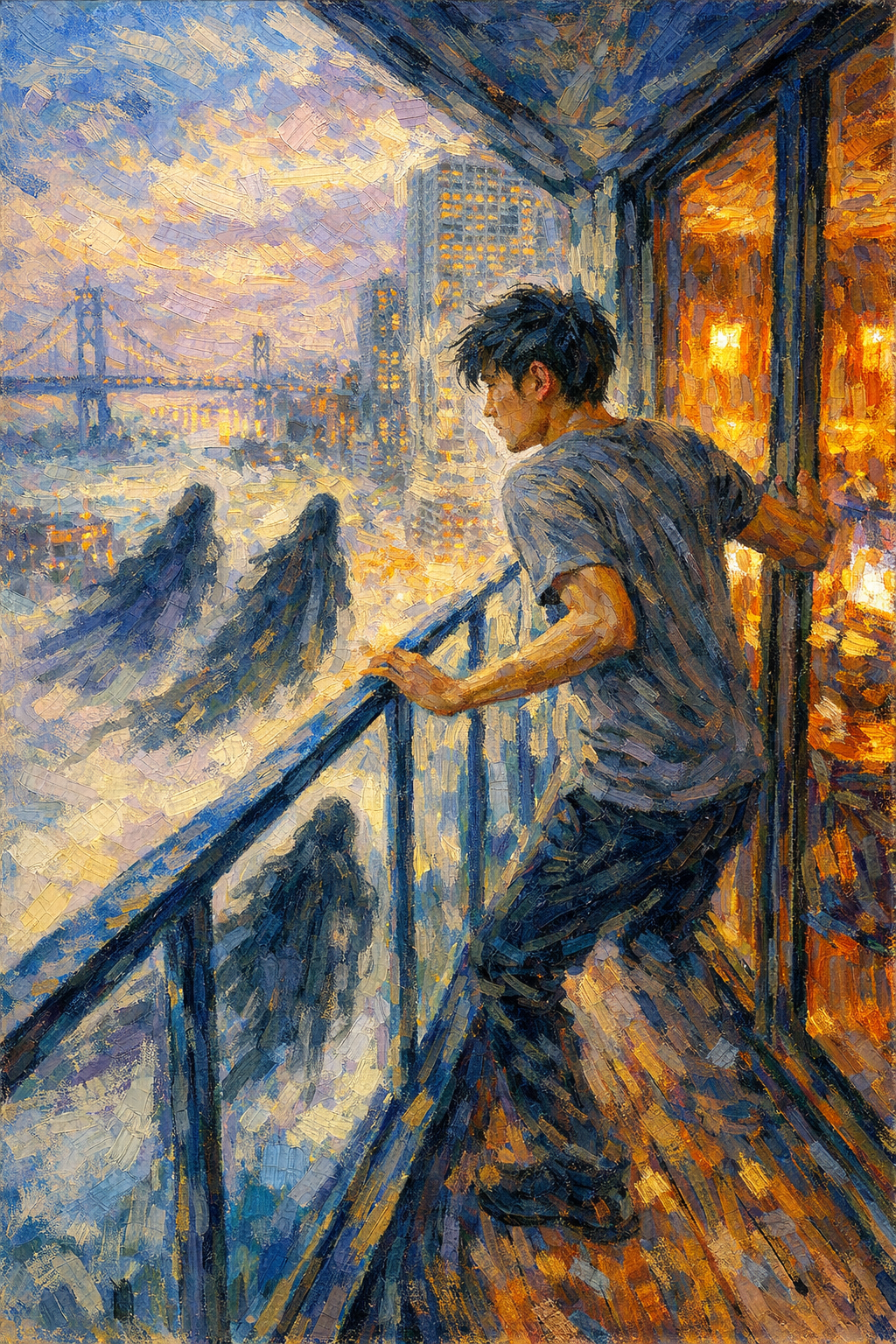
    Dayeng lived alone in a luxurious one bedroom apartment on the twelfth floor of the village suites in San Francisco. From his balcony, he could see the bay and he would often sit on his balcony watching the ships pass beneath the bay bridge through the fog. 

    Dayeng was 27 years old and worked as a software engineer for a relatively large company in the city. He was good at his job, though not the best at it, and he was well-respected by his colleagues. 

    Dayeng was originally from China, though he had not lived there since he was a young child. His parents had moved, along with his younger sister, to America when he was very young. His English was excellent, he was well educated, and American by all accounts. 

    Dayeng had been working in the city for the past two years, having moved from a smaller town in Arizona where he had gone to college. 

    Dayeng had never had a lot of money, though he was never wanting, but with this new job in the city, he was making more than he had ever imagined. 

    Dayeng, being a software engineer, absolutely loved tech—everyone who knew him would say it was his passion—and he was adamant about acquiring the latest and best gadgets to improve every aspect of his life. His apartment was a pride point when it came to this—for it was equipped with every smart gadget you could imagine—with all of the latest and fanciest features—and it was quite a little slice of paradise to live in because of this. 

    It was a Friday, the night of February 13th, in fact, and Dayeng had just finished work. Although he was not currently seeing anyone special, because tomorrow was Valentines Day, he had made plans to go out with coworkers tonight at a bar in the city. 

    “We’re going to find you someone tonight,” Matt said, playfully, giving Dayeng a pat on the back. 

    Matt was an engineer too, but unlike Dayeng, he came from a very wealthy family and a prestigious school. He was much more extroverted than Dayeng, and much more well-connected, but the two had become friends due to their passion for technology and shared sensibilities. 

    Dayeng always felt a bit out of place when he would go out with Matt and the others, but he was happy to go along, and so he mostly stayed by Matt. The extrovert/introvert friendship is always a rare one, but when it happens it usually is quite strong. 

    “No way,” Dayeng said, smiling—embarrassed. “I just want to get a few drinks, maybe listen to some good music.”

    “I don’t think there will be a band at the bar,” Matt said. “It’s in the Tenderloin—remember, the one we went to last month for Claire’s birthday.”

    “Oh that place?” Dayeng said. “It’s super small, though. Why there?”

    Matt paused, glancing around at the other coworkers who were talking amongst themselves on the crowded subway. Then he leaned in close and said quietly:

    “Claire wants to go,” he said, glancing back to make sure she wasn’t listening. “She wants to see the bartender. Remember?”

    Dayeng did remember. Though it was vague, as he had been quite drunk. 

    “The homeless-looking guy?” He whispered to Matt. “The crazy guy?”

    Matt nodded, almost solemnly. 

    “Do you think that’s a good idea?” Dayeng asked, again quietly as he could. 

    “What am I going to say to her?” Matt said, a bit flustered. “She already knows I like her, and if I tell her he’s a creep then she’s just going to think I’m jealous—which I’m not,” he said, adding the last bit with self-consciousness. 

    But Dayeng just nodded. He glanced around at the subway crowd. It was thicker than usual—probably because of the holiday weekend. 

    The arrived at the bar at about 6:30 in the evening. It was almost completely dark and the group—which consisted of Dayeng and Matt, Claire from HR, Donna and Lee from software too, and then Gare from sales. Dayeng loved Gare—he was loud and hilarious, and though they were not close, he was glad the man had come out with them. 

    They took the small table in the back and ordered the first round of drinks. 

    “To Saint Valentine!” Gare said, raising his glass. 

    The others laughed and cheered—though Gare had already removed his glass and began drinking. 

    “I wonder how the ‘Cheers’ thing started?” Claire asked, in her curious and innocent way. 

    “It was probably during the Renaissance, or like, Medieval times, “ Matt said, trying to sound smarter than he was. “Like during big feasts or something.”

    “Fascinating.” Lee said, feigning a yawn. Donna laughed. 

    The two were quite close, and both were quite snarky and sarcastic. 

    “Oh my god…” Claire said, suddenly, slouching down in her seat. 

    The group turned to see what she was looking at. The bartender from the last visit had just come into the bar from the back patio. 

    Dayeng could see why Claire had a crush on him—though he did not like the man. He had long hair—black—and walked with a cool, long stride that was effortless yet intense. But the man was filthy—he looked homeless, Dayeng thought—his clothes were torn and loose, but not in the stylish way you see the college kids dressed like in Haight—Ashbury. His clothes were genuinely dirty, as if he had been rolling around in the street or something. 

    But the bartender had no look of weariness about him. Quite the contrary. He was animated and quick and full of energy. Unusual and quite charismatic, Dayeng thought. 

    “Go talk to him,” Lee said, giving Claire a nudge. “He’s just a person, after all.”

    “She needs a wingman,” Donna said, shoving Lee. “Go on, Queen.” 

    “He looks homeless,” Gare blurted out, louder than Claire would have liked. She winced and gave him a “shh,” though he had said what they were all thinking. 

    “Maybe he is.” Lee said, “just go talk to him, girl.”

    “Come with me!” Claire said, grabbing Lee’s arm. 

    “No way, girl. Not until I’ve had two more drinks at least. Matt, you go with her,” he said, giving him a sly little sadistic smile.

    “Fine,” Matt said flatly. “Claire, if you want to meet him I’ll come with. Dayeng will come too.” 

    He glanced at Dayeng, desperately wanting the emotional support, and Dayeng, in spite of himself, nodded in agreement. 

    The three of them stood up and approached the bar. 

    “Hi,” Claire said, waving the bartender over shyly. “It’s Cliff, right? Do you remember me?”

    The bartender met her gaze with a swift turn and stared at her blankly for a moment. Dayeng felt as though the man was looking straight through her, and thought he might not even have understood her, but then he spoke—clearly and harshly:

    “Claire, the human resource, yeh?” Cliff said, turning to Matt and laughing. Matt did not join in the laughter, though Dayeng secretly thought it was a but funny. 

    “I’m more than a job title,” Claire said hotly. “Anyway, is there a bartender back there who can get us drinks?”

    “Hey, I was only playin’,” Cliff said, looking annoyed. “What are you all having?”

    “What do you recommend?” Matt said, taking the tense moment to insert himself into the conversation. It was clear from his tone that his politeness was feigned.

    “For you lot?” Cliff said, leaning against the bar and eyeing them and the others in the back. “Maybe something craft-like. We got some good breweries that stock us—“

    “—what would you drink?” Claire blurted out, louder than she intended, a note of anger still in her voice despite her interest in the man. 

    “Me?” He said, a bit surprised. “Rum and coke, maybe. Or a lost coast—“

    “—We’ll take seven rum and cokes,” she interjected sharply, with a bossiness that Dayeng could tell made Matt uncomfortable. She pulled her designer wallet out of her purse and laid her black credit card on the counter. “One of those is for you if you want it,” she added, turning away haughtily. Matt winced. 

    The bartender stared at her again, with that same, glassy expression, then spoke:

    “Sure, why not,” he said cheerily. “Place is slow right now, anyway.”

    Dayeng, Claire, and Matt sat back down at their table and within a few minutes Cliff came out with the drinks and pulled up a chair. He flipped it around and sat backwards with an agility and confident precision that took Dayeng by surprise, though the rest seemed only to notice his dirty clothes. 

    “What’s up, bro—loving the vibe in here,” Gare said, welcoming the man into the group. Gare was already quite tipsy and enjoying himself. 

    Donna and Lee were texting each other, and then Lee spoke:

    “How do you like working here?” He said with a tone that Dayeng thought was quite condescending. 

    “I do it for the booze,” He said, laughing. “They don’t even pay me.”

    “Wait, what?” Claire interjected sharply. “They don’t pay you?”

    “Isn’t that, like, illegal?” Lee said, his expression as condescending as his tone, as he glanced at Donna, mouthing, “Oh my God.”

    “Well, I don’t need it,” He responded, glancing back at the bar to see if it was busy. 

    “You look like you need it,” Claire said, giving him a disapproving look. 

    Cliff just stared at her blankly again. 

    “Looks can be deceiving,” he said flatly. “You know the first people had a story about that. The acorn maidens.”

    Dayeng leaned in and so did Matt. Claire was listening but with a strong look of disapproval and Lee and Donna were quietly laughing at the man. Gare was still focused on his drink. 

    “You haven’t heard it?” He said, his glassy eyes sparkling a bit. 

    Claire and Matt shook their heads. 

    “You see, there were three sisters, and the chief in the sky told them that winter was coming soon, and they were each to make themselves a hat. One of them finished it in time but the other two failed and then winter came and the chief in the sky turned them into acorns. But surprisingly to the first people, the acorn with the full cap is the last one you’d ever eat.”

    “So it sounds like the one who finished it was the smartest, because now she won’t be eaten,” Claire said, intrigued by the story, but clearly taking the opposite point of view as Cliff.

    “Well, that’s one way to look at it,” he said blankly. “But there are other ways too.”

    “What do you mean?” Claire responded hotly. “The God or whatever told them that the hat would protect them from winter and it did—from being eaten by savages,” she added the last part harshly, then clearly regretted it instantly, and added: “I mean, not savages, like you know, Indians—native people.”

    Cliff stared at her blankly. Dayeng was fascinated by the man. He clearly must have some personal ancestry that was Indian, or something similar, but he was not phased at all by Claire’s harsh words.  In fact, he almost seemed to look on her with pity.

    “Food is a gift,” he said, calmly. “It was, and is, something you honor before you take it. So no, I think that the story shows that beauty and taste, I suppose, are not on the surface.”

    Claire just stared at him. “I guess,” she said. “But you might have got that wrong.”

    “I think I get it,” Matt interjected. “It’s like, you’d think the more protected acorn would taste better but it’s the opposite.” 

    Claire turned at him, giving him an angry look.

    “I mean, but I can also see Claire’s point. From the acorns perspective.”

    Cliff smiled, the first time he had really done so with authenticity. “Yes, there’s always more than one perspective.”

    He paused and lifted his drink, staring towards the bar door as a large crowd came in. He finished his drink then stood and spoke, spinning the chair around and placing it lightly back at the other table.

    “Thanks for the drink,” he winked at Claire. “Hope you all have a good night—duty calls code 333.” 

    As he said this last bit he stared at Dayeng, for some reason, who he had not spoken to once, and Dayeng was overwhelmed by the urgency in his gaze. Not about work, no. About something else that unsettled Dayeng deeply though he did not understand what it was.

    He strode back to the bar and, animated and friendly, greeted the newcomers. 

    “What a strange King,” Lee said, laughing. “Glad he’s gone.”

    Dayeng leaned over to Matt, who was sipping his drink lost in thought. 

    “Hey—what do you think he meant by code 333?” Dayeng asked quietly, picking up his rum and coke for the first time.

    Distractedly, Matt replied: 

    “Huh? Oh, I didn’t hear that. Wait, is that Jaxon!?” 

    Another one of their coworkers had just come into the bar. Matt leaped up and headed to greet him, though Dayeng stayed seated. He only knew the man by name, and was not well acquainted enough to drunkenly greet him on a happenstance meeting. 

    “Dayeng,” Lee said, taking down the last small sip of his drink.

    “Yeah?” He responded, leaning in towards the drunken, whispering Lee.

    “Do you have your bug bag?”

    Dayeng eyed Lee, then squinted reluctantly, the man was clearly exactly what he thought he was. 

    “I do,” Dayeng said. 

    “Well, can we give that bartender some bed bugs?”

    Dayeng leaned back putting his hand up to his head. He kind of liked the guy, though he didn’t say this, and only said:

    “I don’t know if I want to waste another one,” he said, sighing. 

    “Come on, I’ll buy it from you,” Lee said, smiling his little sadistic smile.

    Dayeng sighed again. “Fine, just give me a second.”

    He stood up and made his way into the bar restroom where he entered the stall in the back and locked it. He opened his backpack and took out one of the little black bugs—he’d bought ten of them about six months ago for about a thousand a piece. Which was a great deal for the power and accuracy of the sound from such a miniscule piece of tech. 

    All you had to do was stick one somewhere, and you could pick up any sound crystal clear within about 100 yards. You could even isolate certain areas. They had figured, after he had shown Matt and Lee, that if they stuck them on a person, somewhere that they wouldn’t notice, you could essentially listen to them wherever they were. The hard part was finding a spot that they wouldn’t notice. Strangely enough they had found that the back of the head, beneath their hair, kept the gadget secure and—because of it’s miniscule size—most people would run their hand right past it. And of course, the gadget was water proof, pressure proof, shock proof, you name it. Even geo located.

    Dayeng slipped his backpack back on and exited the restroom and sat down next to Lee at the table. 

    “Here you go,” he said quickly, slipping Lee the bug under the table. 

    Lee had his phone out and ready and sent Dayeng the money. Then he stood up quickly and headed for the bar. 

    Dayeng watched as he waited to get the attention of Cliff, who was busy chatting with some newcomers, and when Lee finally got his attention, Dayeng watched his animated and friendly performance as he chatted and subtly flirted the man up until he had a drink in hand and he leaned it to give the man a hug—ending with a well-timed pat on the back and then back of Cliff’s head.

    When Lee got back to the table, he took his phone out, and put in his headphone. 

    “It’s working,” he said, smiling. 

    Dayeng had finished his second drink and Claire had already ordered another round and before they knew it they were all sloshed and in a ride share heading home. Dayeng forgot all about the bug. 

    He woke up the next morning to the blinding sunlight of a hangover as his smart curtains slid open on their own at around 9 am.

    “Damn,” he said then scrambled for his phone to shut the curtains. The smell of his timed coffee maker only made him sick, and he shut that off too. 

    He laid in bed, scrolling on his phone, exhausted and hungover, until he remembered about the bug and the bartender. 

    He texted Lee, who immediately responded with the link, and Dayeng opened it. 

    It was quite. Dayeng searched for voices, but the man must have been asleep still. The suddenly, a loud voice rang out throughout his entire apartment. Dayeng had not realized that his phone was connected to his speaker system and suddenly, the audio from the bartender’s bug was playing in his apartment. 

    He tried to lower the volume, but he couldn’t. So he laid there, frightened, listening. The voice was dry and coarse, old and wiry, and Dayeng could think of no other word than evil to describe it. 

    “Yu’bui ni ya’m min ya’miim—yu’bui ni ya’m min ya’miim—yu’bui ni ya’m min ya’miim.”

    The terrifying voice spoke this unknown phrase three times, loud and with vitriol. Dayeng, lay there, frozen—listening. Then all was quiet. He checked the app and saw that the bug had disappeared. It was no longer connected or accessible to him. 

    He texted Lee: what the hell was that???

    Lee did not reply. 

    The suddenly, all of the electronics, including the enormous flat screen TV in the main room turned on. The volume blared, the TV changed channels, fluctuating between static and violent images. 

    Dayeng rushed to turn them off but couldn’t until finally he pulled this plug. His tea kettle was boiling, his coffee maker overflowing, the curtains sliding back and forth, and then his vacuum began crashing into the walls and knocking books and vases off his shelves. 

    “What the fuck is going on,” he yelled. 

    Overwhelmed and terrified, he scrambled to his front door. But the digital lock wouldn’t budge. He tore out his phone and desperately tried to unlock it but even his phone was malfunctioning, moving and deleting and sending messages of its own. 

    With no thought of what else to do, trapped inside his malfunctioning tech paradise, that had so quickly become a hell, he ran to the balcony, opened the glass door, and slid it shut. 

    He let out a sigh. It was quiet out here. He glanced at the midmorning sun rising over the fog on the bay. 

    But then something caught his attention out of the corner of his eye below him. He leaned over the balcony. 

    There were three dark shadows gliding up the building towards him. Slowly but quickening. They looked like cloaked figures, but were moving at a pace that was not of this world. 

    His heart dropped into his stomach and his face turned gray and he turned quickly to open the sliding glass door but it wouldn’t budge.