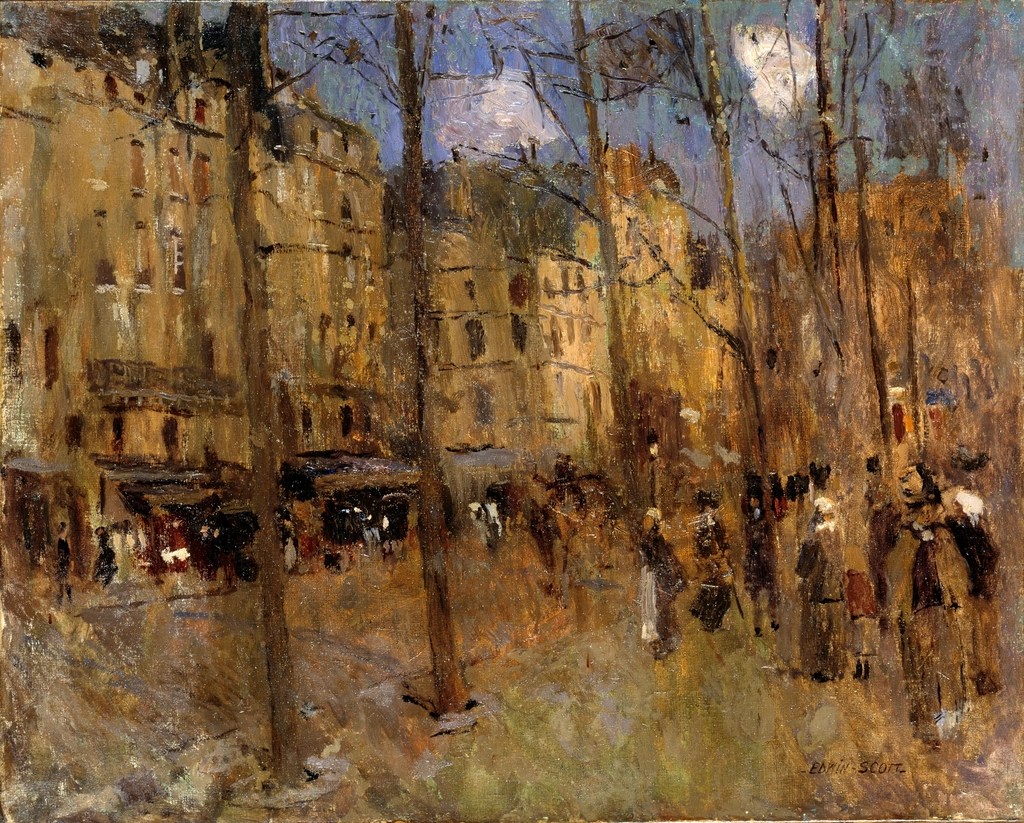
Tag: short story

  • The Accordionist On Rue De Bienveillant 

    The Accordionist On Rue De Bienveillant 

    Simone worked at a small tobacco shop on the corner of Rue de Bienveillant in the heart of Paris. Her days were long and the job did not pay her well. She had always wanted to travel and explore the world—perhaps visit Japan or America. However, between her day to day worries and the rhythm of life in the city, she had never made the time to really look into it seriously.

    She had begun working at the tobacco shop when she was in school, however, during that time she had become pregnant and had never finished. Since then, she had stayed at the shop, working long hours to support herself and her daughter. 

    The street of Rue de Bienveillant was not unlike many of the smaller streets in Paris. There were times when it was quite busy, with many people walking through to the larger streets on either side. There were also times when it was so quiet that she wondered whether or not she was still in one of the grandest cities in the world or a small town to the south.

    During these quiet times, every now and then, an old man would sometimes begin to play his accordion in the street, a few shops down from Simone’s tobacco shop. She remembered hearing him playing when her daughter was only a few years old, and she had been so busy that she had never thought to stay and listen to him. She simply walked by him and would toss a few coins in his basket. 

    But over the years as things slowed down and Simone began to settle into her life, she noticed the old man more and more. She often wondered as she would pass him after leaving work why the man did not play during the busiest hours, but instead seemed only to play during the quiet times, late at night. 

    She suspected that the man lived in one of the apartments above the street, and perhaps came down to simply enjoy the sound of his music out in the city. 

    One night, she had had a particularly stimulating day in the shop—as a group of raucous foreign businessmen had spent a few hours there, talking to her about their travels—and so, being in such good spirits, she decided to stop and speak with the old accordionist. 

    “Why don’t you play along the big street, on the corner?” She said quickly, as she tossed a large handful of coins into his basket. She noticed that it had been empty before she did this, as it always was. But the old man only shook his head dismissively, and continued to play. 

    “What is your name?” She asked, determined to learn something, anything, about this man. 

    He looked up at her, still playing, his face very old and his eyes full of sadness. He said nothing, only continued to play. 

    “Well,” Simone continued, startled by the man’s eyes. “I hope you have a splendid night, Monsieur. I very much enjoy your music.”

    She gave the man a nod of respect, understanding that he did not wish to converse with her, and then headed towards the metro and to her home. 

    She never spoke to the man after that, however, whenever she did pass him on the little cobblestone street, she still always threw a few coins into his basket. 

    ~ ~ ~

    Years later, her daughter had grown and was quite a fine young woman—quite beautiful and with strong academic promise. She had been accepted to a university in Tokyo with a full scholarship, and Simone had seen her off to Charles de Gaulle airport with more than a few tears in her eyes. 

    She did quite well, and though Simone kept in touch with her, the calls came more and more infrequently as her daughter became adjusted to her new life. 

    It was during these years that Simone began to become sick. Not severely so, but she began to feel bouts of tiredness and pain. 

    When she went to the doctor, they told her that she was unwell and would no longer be able to work at the tobacco shop. They said the smoke, from the years and years of it, had caused her to develop cancer. She could not afford the treatment, and so the doctor recommended rest. 

    Her daughter told her of a new treatment in Tokyo, but it was quite expensive. 

    “It looks very promising mother! You would just need enough for the visit and the treatment, I can help as much as I can, but you will still need to find the money.”

    Simone hung up the call, and let out a long sigh. She was so tired. She knew she would not be able to find the money, and so she lay down on her bed, listening to the city below her, and fell asleep. 

    She awoke several hours later to a knock at her apartment door. Standing up, slowly, she straightened her hair, wondering who it could be. She received very few visits these days. 

    She opened the door, expecting to see her friend Lea or possibly a neighbor in need of something, but there was no one there. 

    She glanced around, before noticing a small envelope on the floor in front of the door. She bent over, picked it up, and read the small, messily scrawled words on the unstamped envelope. 

    It read: 

    “From the accordionist on Rue de Bienveillant.”

  • String (short story)

    String (short story)

    Alfred was sitting on his bed, his neck half propped up against a quite unfortunately abused pillow, scrolling on his phone, when he felt a sudden itch in his nose.

    Reactively, he reached his left hand up to scratch it, thinking it may have been a speck of dust or a gnat or just a random itch, only half speculating. 

    With the itch resolved he lowered his hand. But then it came back, this time more immediate and much more irritating.

    Alfred stood up quickly and reached for the box of tissues by his bedside. He blew his nose firmly, thinking that this would be the end of it, balled up the tissue, and then tossed it in the small, plastic wastebasket in the corner of the room.

    As he turned to return to his bed, he looked down and noticed a piece of string—hanging right in front of him—hanging from none other than his left nostril. 

    His stomach lurched in disgust, and he stopped, reaching up carefully to remove it. But as he began to pull the string, it only kept unraveling and unraveling—longer and longer, coming from deep inside his nasal cavity. 

    Alfred was feeling a strange mix of terror and disgust as he kept pulling this mucus covered string from out of his nose, unsure if whether or not this would be his undoing. He pulled slowly on the string until some four feet’s worth of it hung in front of him with the end still not visible or noticeable in his nostril. 

    Finally, after about six feet of string slid irritatingly through his nasal canal, he felt a lurch and felt a clump inside his upper airway attached to the piece of string. 

    With disgust and panic he yanked the string hard with one pull and out of his nose came a little ball of paper, attached to the end of it. It landed in front of him on the floor. 

    Alfred looked at this strange thing, then glanced around wondering whether this was a dream of some sort. No, this was waking life, he was sure of it. But what on earth was this string doing inside his nose and how had he not felt it before? He knelt down beside the balled up piece of paper attached to the string and examined it. It seemed to be some kind of little crumpled up note.

    With disgust, he pried the mucus covered thing apart, a sense of dissociation coming over him at the strangeness of the situation, until it lay open in front of him.

    It simply read this: “smell yuh later.”

    Alfred sneezed, threw the note and string into the trash, and plopped back down on his bed to proceed to continue to scroll on his phone. 

  • Upside Down (Short Story)

    Upside Down (Short Story)

    It was a few minutes before six in the evening and I was waiting for the bus after leaving work to head home. It was an ordinary day and I had no reason to feel any differently than usual. I guess the only thing out of the ordinary that had happened was that I had seen something peculiar that morning. 

    When I had taken my first smoke break of the day, I had decided to take it on the roof of the office building where I worked. This was not unordinary, as I would either take my break there or outside the building in front of the entrance. 

    But as I had been smoking, I happened to glance up at the sky. I saw a white bird, of which kind I could not say, however, it was flying upside down. I squinted against the morning sun to be sure I was not confused, and sure enough, the bird circled the rooftop and then flew off to the east—the whole time flying upside down.

    Strange, I thought to myself, ashing my cigarette in the little ashtray the smokers of the office had placed there. I did not know that birds could fly upside down.

    I went back to work, thought nothing of it, and had finished the day as I normally would. I said a brief goodbye to Lindsay at reception and then took the short walk through the building and down the street to the bus stop. 

    But while I was waiting for the bus, the sun staring to set, the upside down bird came back to my mind. It had been beautiful in a strange way—graceful—and had I not looked closely I would have not noticed this strange behavior. 

    The bus pulled up and I climbed up the steps, giving a little nod to the driver, and then settled into a window seat in the back row. That was where I always sat. I always felt more comfortable being out of any stranger’s direct eye line. 

    After about twenty minutes, watching the city slide by with it’s grays and greens, we arrived at my stop—as any other day. But instead of standing up and shuffling off of the bus, I instead, stayed seated. 

    I am not sure why I did this—for it made no logical sense to stay on the bus. I knew the next few stops were mostly residential and I should go home and eat dinner—but my body simply seemed to decide that it was not going to move.

    Before I knew it, I guess I had fallen asleep, because I awoke to the bus driver tugging at my sleeve.

    “Last stop! You gotta move, sir.” 

    Confused and disoriented, I hazily stood up and exited the bus with the bus driver frustratedly shewing me towards the door. 

    The bus pulled away and I was left, standing there and rubbing the sleep from my eyes, under the flickering light of an unknown street lamp. 

    Where am I? I thought to myself. 

    I looked up at the street sign. Then I rubbed my eyes in confusion. I couldn’t understand it for the life of me. I walked towards it, feeling a strange sense of dread. 

    As I got closer, I realized that the letters were upside down, and—upon closer inspection and a twisting of my neck—I was able to read it. It said, Culvers Rd—the very same street that I lived on. 

    Ah, some kids must have vandalized it—switched the sign. I thought, relieved. Somehow I guess I had still ended up at my stop. 

    I began to walk down the street towards my house, approached the front door, fumbling loudly with my keys. 

    But before I could even put them in the lock, the door swung open. 

    “Mr. Johnston? Is everything alright?”

    I jumped in surprise and then looked up at—what I now realize—was the face of my neighbor. 

    “What are you doing in my house?” I said sharply, without thinking. 

    My neighbor—Mrs. Rhinestone—cocked her head in confusion with a frightened look in her eyes.

    “But, Mr. Johnston, this is not your house,” she said cautiously, then added, “Are you feeling alright?”

    I stared at her in disbelief. Was this some practical joke? But no, she was as sincere as can be. 

    “S-Sorry,” I said, stepping backward. “Long day.”

    I turned, thinking hard, and walked back down the path and down the driveway. I glanced back cautiously to see she had shut the door already, but I saw the curtains moving beside it, and knew she must be watching me. 

    I crossed the street, then turned, and saw the curtains were still moving. 

    I was quite concerned now, for that house was undoubtedly mine. I had looked through those very same white curtains many times. Even the car in the driveway was mine—or was it? What kind of car did Mrs. Rhinestone drive? I couldn’t seem to remember. 

    Now, conscious of her suspicion and her eyes on me, I turned and walked up the driveway of the house across the street. I slowly approached the front door, glancing subtly back at my house, and I saw that the curtains were no longer swaying. 

    Mrs. Rhinestone must think I live here…

    I glanced around. There was no one out. No cars along the quiet street. Just the light from the street lights that turned on automatically at dusk. 

    I reached for my keys and tried the lock. The door swung open. 

    What the hell is going on? I thought to myself as I stared into the dark entryway of what I was certain was my neighbor’s house. Do I go inside? Do I call the police?

    Then—suddenly—I heard a loud siren blare several streets away, and it’s intensity startled me enough that I simply entered and promptly shut the door. 

    “Honey, is that you?” A soft and far away woman’s voice called from the other room. 

    “A-Amy?” I said weakly, my lips beginning to quiver.

    Then, from the other room, my ex-wife entered—her hair long and flowing hazel brown with smiling eyes that looked on me with all of the love and care that I remembered so well. 

    I reached out, my hand trembling, and took her hand. It was warm and soft and she leaned in close and I smelled lilac and roses and as I glanced down I saw the bulging white scars on her wrist from her suicide.